What to Do with Your Pet's Belongings After They Die
There is no right time to pack away your pet's things. Here is a framework for one of the most practically and emotionally complicated parts of the early grief period.
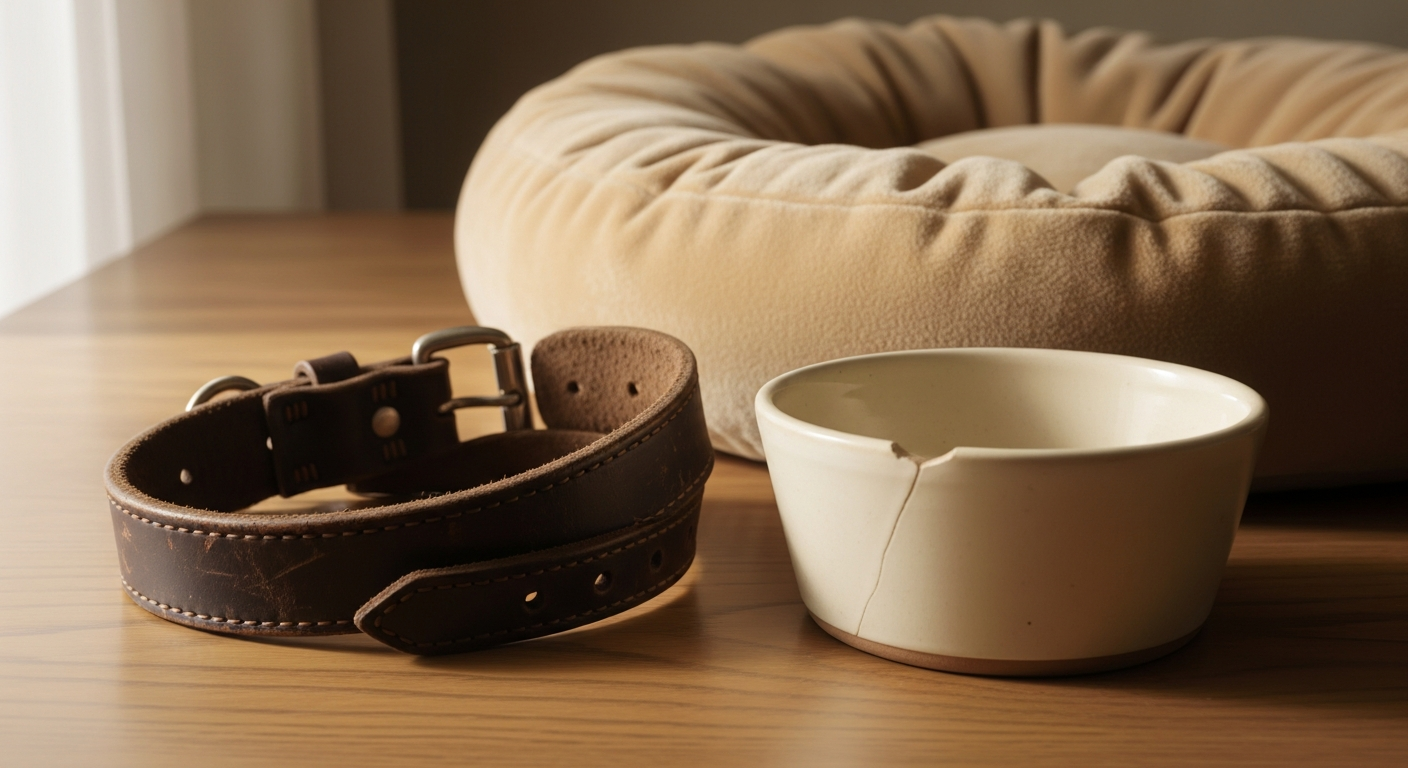
The Bowl Still on the Floor
In the hours and days after a pet dies, many people find themselves unable to move things. The water bowl. The bed. The lead hanging by the door. The worn spot on the couch.
And then they start to wonder whether they should.
This is one of the most practically and emotionally complicated parts of the early grief period, and it deserves more honest conversation than it usually gets.
There Is No Right Time
The most important thing to say first: there is no correct timeline for when to move, pack away, donate, or keep your pet's belongings.
Some people find that keeping their pet's bed nearby for months provides comfort — it still smells like them, it holds the shape of them, and it makes the loss feel less erased. Others find that seeing the bowl empty every morning is a specific kind of pain they cannot sustain, and packing it away quickly gives them a small measure of relief.
Neither of those responses is more correct than the other.
The discomfort often comes not from your own instincts but from other people's. Someone may gently suggest it is time to clear things out. Someone else may tell you that keeping a shrine is not healthy. Most of those suggestions reflect the other person's discomfort with grief more than they reflect any real knowledge of what you need.
You are allowed to move at your own pace.
What Actually Matters
A few questions worth sitting with:
Does having the item nearby bring you comfort, or does it bring you pain? Both are valid answers, and they may change day to day. On some days, your pet's bed may feel like a connection. On others, it may feel like a wound. Neither response is wrong, and neither commits you to a permanent decision.
Are you keeping things out of love, or out of avoidance? This is a harder question. Sometimes keeping a pet's things unchanged for a very long time is a way of refusing to let the death be real. If you notice that thought in yourself — that moving things would make the death feel final in a way you are not ready for — that is worth paying attention to. Not because you are doing something wrong, but because it may point to grief that needs more support than time and silence.
What would feel like honoring them? Some people donate their pet's food and remaining medications to a shelter or rescue. Some keep a collar or tag as a keepsake and let the rest go. Some create a small memorial space with one or two meaningful objects and pack the rest away. There is no formula. The question is what feels like an honest acknowledgment of the relationship you had.
On Being Pressured
If someone is pressuring you to clear things out before you are ready — even a well-meaning person, even someone who loves you — you are allowed to say no. You are allowed to say "I know it seems like a lot, but I'm not ready yet, and that's okay."
Grief is not something others can schedule for you.
On Keeping Things Forever
There is also no rule that says you have to let things go. Some people keep a collar in a drawer for years, or frame a photograph, or keep a small dish on a shelf. Continuing to hold space for an animal who was central to your life is not pathological. It is love finding a form it can live in after the death.
These frameworks are a starting point, not a substitute for real support. If the grief is sitting heavily — affecting your sleep, your work, your sense of yourself — reading about it only goes so far.
Book a grief support session with Dawn — a one-on-one space to bring whatever you are actually carrying, without having to explain yourself first.
You don't have to carry this alone.
A free 15-minute call with Dawn. A 1-to-1 space to bring whatever you are actually carrying, without having to explain yourself first.
Book a Free Grief Support CallNot ready to call? See all support options
More gentle readings
What Not to Say to Someone Grieving a Pet (And What to Say Instead)
Most people say the wrong thing after a pet dies — not from cruelty, but from not knowing what helps. Here is a plain-language guide to what to avoid, and what actually lands.
When Pet Grief Does Not Lift: Understanding Prolonged Grief
For a significant number of people, grief after a pet's death persists well beyond what the people around them expect. Here is what prolonged grief disorder actually is and what helps.