How to Memorialize Your Pet: Ideas That Actually Honor the Relationship
Memorialization is not about replacing grief with sentimentality. It is about creating meaning from the loss — honoring the specific animal you loved in a way that is true to who they were and who you were together.
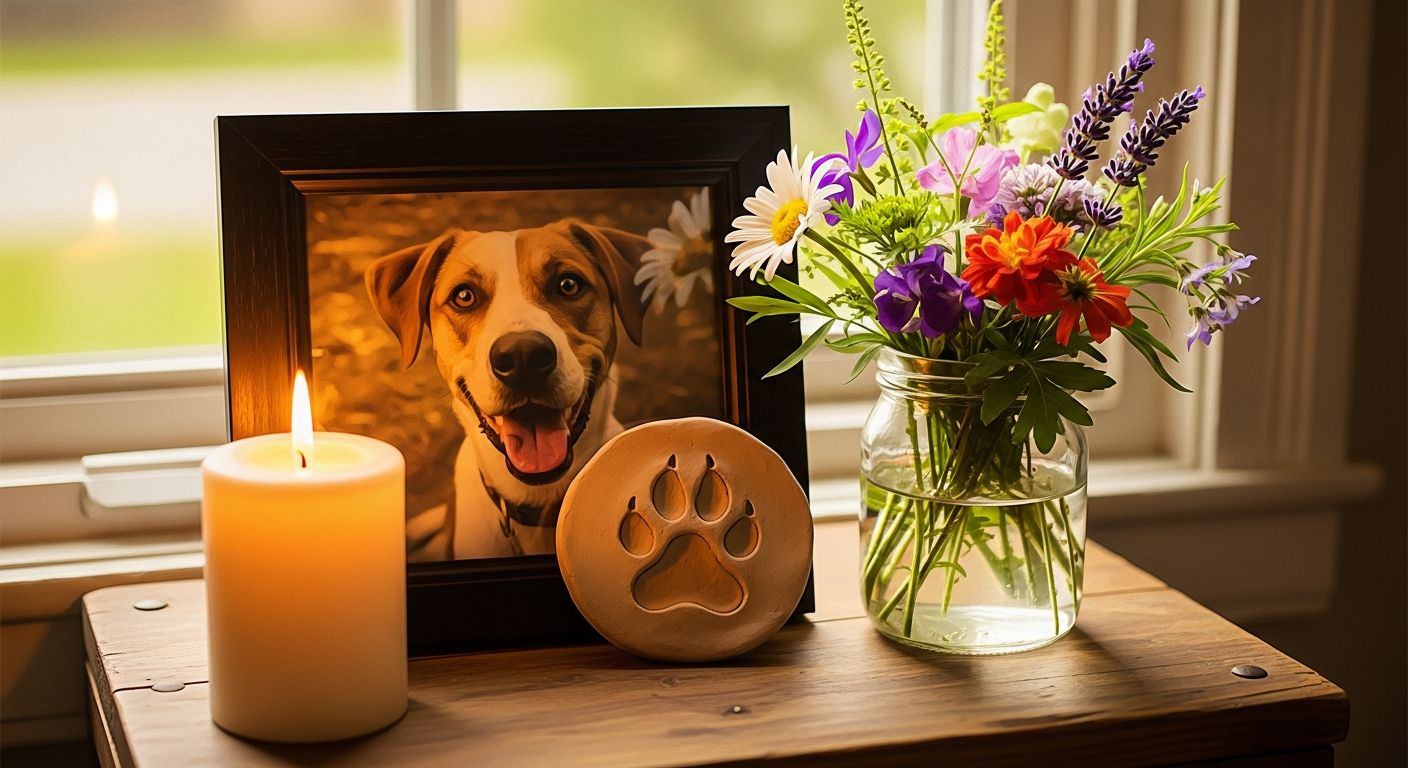
Why Ritual Matters in Grief
Grief research consistently finds that ritual — intentional acts of honoring and marking — helps grief move.
This doesn't mean grief is resolved by lighting a candle. It means that acts of intentional meaning-making create anchors in the experience, places where the love has somewhere to go rather than just circling. Ritual acknowledges: this happened, this mattered, this animal deserved to be honored.
The memorialization that matters most is the one that is true to your specific relationship. There is no memorial that is too small, or too simple, or too personal. The right choice is the one that feels like your pet.
Physical Memorials
Paw print impressions. Many veterinary clinics will take a clay or ink impression at the time of euthanasia. If yours does not offer this, you can purchase paw print kits to do at home before or after the death. Prints made in the last weeks are often more meaningful than ones made earlier, though any impression holds the shape of the animal.
A tuft of fur. Hair or fur, kept in a small envelope or a keepsake locket, is a way of holding something of the physical animal. Some cremation services include fur in the ashes return; you can also ask to save a small amount before the body is taken.
Custom portraits. Commission an artist to paint, draw, or illustrate your pet from photographs. There are many artists who specialize in pet portraiture, from realistic oil paintings to simpler illustrations. Having a piece of art that holds your pet's specific face and character is something many people find deeply comforting long after the acute grief has shifted.
Memorial garden stones. An engraved stone placed in a garden, a yard, or a meaningful outdoor space gives the grief somewhere physical to go. Some people plant a tree or a particular plant in their pet's memory, something that grows and changes with the seasons.
Ashes. If you have chosen cremation, there are many options for what to do with the ashes: keep them in a meaningful urn, scatter them in a place your pet loved, incorporate them into a piece of memorial jewelry, or have them pressed into a stone or crystal. None of these is more right than another.
Ritual Practices
Writing a letter. One of the most consistently helpful grief practices: write a letter to your pet. Tell them what they meant to you. Tell them what you were afraid to say. Tell them about the guilt, if there is guilt. Tell them about the specific ordinary Tuesday that you miss most. You do not have to share this letter with anyone. It is for you and for them.
A memorial meal. Some people prepare their pet's favourite foods one more time — a meal that will never be eaten, but that is made in love. This sounds small and is not.
A walk to their favourite places. After a dog's death especially, revisiting the places you went together — the park, the trail, the coffee shop that always let them in — can be both painful and meaningful. It holds the memory of what was.
An anniversary practice. Grief doesn't observe a timeline, and anniversaries — the day they died, their birthday, the day you first brought them home — can bring grief back with unexpected force. Planning something intentional on those days, rather than trying to get through them normally, can help. Some people light a candle. Some look at photographs. Some revisit a meaningful place. The practice itself matters less than the intention behind it.
For Children
If children are also grieving, involving them in the memorial process gives the grief somewhere to go.
Drawing a picture. Writing a story about their pet. Choosing where to scatter ashes or where to place a garden stone. Helping pick what goes in a memory box. Children often process grief through active, creative engagement rather than verbal reflection. Give them a way to do something, not just to feel something.
What Memorialization Is Not
It is not a replacement for grief. A beautiful urn or a commissioned portrait does not mean the grief is finished.
It is not an obligation. If none of these ideas resonate, you are not grieving wrong. Some people's process is entirely internal. Some people need no object or ritual to hold their love. That is also valid.
It is not time-limited. You can create a memorial months or years after the death. The need for ritual often surfaces later, once the acute grief has shifted and there is room to honor more intentionally.
The Thing That Matters Most
The best memorial is the one that feels like them — like the specific animal you loved, with their specific personality, their specific ways of being in the world with you.
Whatever you choose, or whether you choose anything at all, the love underneath the impulse is the memorial. That doesn't require an urn or a portrait or a garden stone. It already exists, in how much you are still carrying this loss.
You don't have to carry this alone.
A free 15-minute call with Dawn. A 1-to-1 space to bring whatever you are actually carrying, without having to explain yourself first.
Book a Free Grief Support CallNot ready to call? See all support options
More gentle readings
What Not to Say to Someone Grieving a Pet (And What to Say Instead)
Most people say the wrong thing after a pet dies — not from cruelty, but from not knowing what helps. Here is a plain-language guide to what to avoid, and what actually lands.
When Pet Grief Does Not Lift: Understanding Prolonged Grief
For a significant number of people, grief after a pet's death persists well beyond what the people around them expect. Here is what prolonged grief disorder actually is and what helps.